Saturday, January 3, 2015

Akeome 2015

今年もよろしくお願いします!

As predicted, it's been a while since my last post (though for different reasons). I hope all you readers had pleasant holidays. Mine were...stressful, but I'm still breathing.

Just last weekend I was over at Mint's place. She's been fighting a cold, and I joked that it would be okay if I caught it since I don't have to go back to work until January 5th. Little did I know that I was already incubating some dread bug, which has been plaguing me since then. No fever, but it's really knocked me on my posterior. Seriously, almost this entire week was spent staring at screens and being unproductive. At least I'm getting my money's worth out of Netflix. I expect I'll be recovered enough to drag myself into work on Monday, but blegh. Blegh, I say! Also, think I've drunk more tea in the past five days than during all of my time in Japan.

I scored some excellent electronics-goodies for Christmas - among them the new Dragon Age iteration and Fantasy Life, as predicted. Those have gotten some time. I finally unfogged enough that I can actually focus somewhat on reading and deciphering things like computer component specs, so I also cracked open my trusty PC today, I think for the first time since putting it together 3 years ago. The occasion was the (successful) installation of a new Western Digital 1TB HDD. I'm glad HDDs are relatively easy to install. I've been doing so much nothing over the past few days that it was nice to feel like I've accomplished something.

I also got some very nice cologne and high quality matcha powder (ゲット!) and a few other goodies that will be enjoyed when I'm in a better condition.

And I haven't forgotten about that Ambition of the Slimes update I promised! I even have the screenshots ready...


Wednesday, December 17, 2014

Holiday Season

Just wanted to pop in to give a quick status update as I've been rather negligent lately on the blog post front. It's been a busy year in terms of preparing for the holidays. I'm not exactly certain why, but it feels like I've done a lot more shopping this year than for Christmases past.

So I sat for the JLPT N1 at the beginning of the month. It was a little rough. I felt like my reading ability has improved comprehension-wise, but I ran out of time before I could finish the section. Guess I need more speed and endurance on that end. Given that I'm shifting to IT study mode, I'm not sure if I'll be working to take it again next year; will have to wait and see on that. I'll just need to be mindful about putting in enough time with Japanese media to make sure I don't lose what gains I've made.

I wish I could guarantee a lot more posts for the second half of this month, but what with Dragon Age Inquisition and Fantasy Life almost certain to come my way for Christmas, plus Suikoden and Suikoden II on my plate...well, it doesn't look too good, I'll be honest. That said, 2.0 of Ambition of the Slimes was released the other day, so I'll try to update the guide soon.

Anyway, that's it for now. Merry Christmas and happy holidays to you all!

Tuesday, December 2, 2014

皮切りにして: Cut the skin

A belated happy Thanksgiving to my American readers. I hope you had a wonderful day and hopefully a little time to relax!

Myself, I'm balancing the relaxation with an increasing need to study. On one hand, I've decided to change tracks and pursue IT. It seems to be a pretty lucrative field with a lot of jobs (as compared to just looking for Japan-related positions), and I've always liked computers. I'm hoping to get my CompTIA A+ certification early next year, but the study guide is 1400+ pages, so...yeah, a lot to go through.

On the other hand, I have no intention of abandoning Japanese. Refocus a bit yet, but I still may have a more serious go at translation someday. And with that in mind, I'll be sitting for the JLPT N1 again this Sunday. I don't feel adequately prepared, but at least I'm still working at it.

And so in the spirit of N1 study, I offer up this grammar point I!

皮切り(にして)

I was going through my good ol' Kanzen Masters grammar study book when I came once more across this one. 皮切りにして (かわきりにして) - "to begin with."

Now I could just file that away and move on, but it I'm more likely to remember if I actually try to figure out the structure behind grammar points like this. Literally, this looks like "Cut the skin and..." And yet it somehow works out to "beginning with." There must be some interesting story behind this expression, right?

Cue the Google digging. Ah, results.

It seems this expression finds its origin in traditional Eastern (Chinese) medicine. Specifically, something called moxibustion. Huzzah for learning new English words, too!

Moxibustion is, apparently, in the same vein as acupuncture. Except instead of sticking people with needles, you stick them with burning, uh...sticks. And this can also be done in conjunction with acupuncture needles. Sounds relaxing, right?


That "being flayed" sensation means it's working.


Well as you might imagine, this can sting a bit. The expression came about because at the start of being moxibusted upon (I'm sure that's not the medical term for it, but please excuse this humble layman), one feels as if one's skin is being cut. Ouch. Hence "Cut the skin" came to mean "to begin with."

And now you know.


Image Source 

Tuesday, November 25, 2014

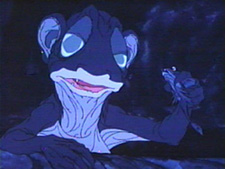
Japanese Gollum

In my researching of the Japanese version of the Hobbit the other day, I was a little let down by the Japanese presentation of Biblo's Egg Riddle. Still, I did come across an interesting translational decision.

In English, the corrupted hobbit-creature Gollum is so named because of the "horrible swallowing noise in this throat." This is illustrated especially well in Peter Jackson's LOTR films, I think, wherein Smeagol periodically coughs out his more sinister moniker, "Gollum." This seems to happen when he is about to give in to his darker nature.


In Japanese, Gollum's name is translated as 「ゴクリ」, which is a gulping, swallowing sound. It's a little more literal than its English counterpart, as "Gollum" isn't a conventional word or sound in English and 「ゴクリ」 is in Japanese, but think this is still a nice way of rendering his name.

It appears that the Seta Teiji, who translated Tolkien's the Hobbit and Lord of the Rings into Japanese, got creative with a number of Middle Earth's proper nouns, and Gollum isn't the only name to have been adapted for Nihongo. 

Some of those other translations may be a nice topic to explore in the future.


Image Source: Wikipedia (Rankin & Bass animation)

Friday, November 21, 2014

A box without hinges, key, or lid...

Today I was thinking a bit about the Hobbit (because that is the sort of thing I think about); specifically about the novel and the old Bass and Rankin animation that had so much charm. Definitely worth a watch!

I've been a fan of riddles for a while now, and it may be that reading and watching the Hobbit as a kid played a part in that. There's one particular short and simple riddle of Bilbo's that I've always loved:


A box without hinges, key, or lid,
yet golden treasure inside is hid.

The answer, of course, is an egg. Or "eggses" might also be acceptable. I was wondering today whether the Japanese version of the riddle is a literal translation, or maybe something with a delightfully poetic spin. The English version rhymes, and rhyming can be quite challenging to translate satisfactorily. The meaning will come across, but the flair, the feeling, some nuance, will often be lost.

A quick Googling brought up an old Japanese Middle Earth blog post from a few years ago, before the release of the recent movies, in which the writer shares the text of the riddles bandied back and forth between the hobbit and the, er...Gollum.

The egg riddle is laid out as:

この箱には、ちょうつがいも、
かぎも、ふたも、ありません。
それでも、なかには黄金の宝ものが、
かくしてある。なんでしょう?

Alas, it turns out to be a literal translation. Functional, yes. But lacking that something.

At any rate, now I totally want to read the Japanese version of the Hobbit. I'll have to add it to the massive queue of J books I have yet to get through!

Tuesday, November 11, 2014

A slime, a goddess, and back scratchers

On one of the updates to my Ambition of the Slimes English guide, I came across an interesting translational situation.

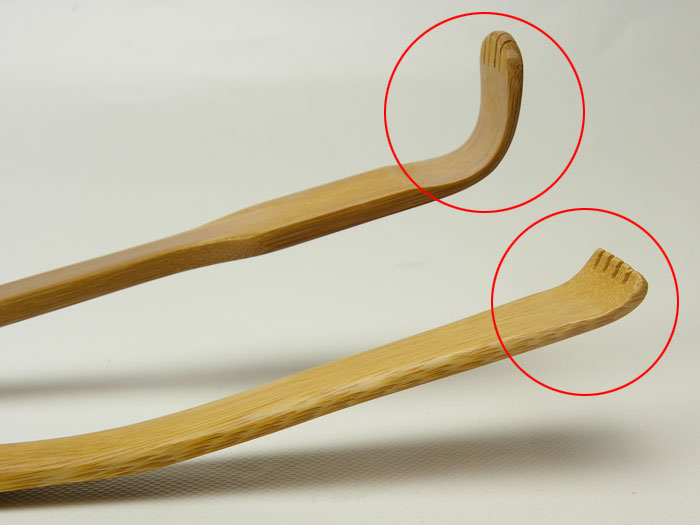
There's a slime called マゴノテ:


Literally, this means "back scratcher" in Japanese.


See the resemblance? The explanation for this slime's name could be as simple as that. However, my research uncovered a little bit of a story behind the Japanese word.

The kanji form of マゴノテ is 「孫の手」, which means "grandchild's hand." 

If you go a little deeper - according to Wikipedia, the word was originally 「麻姑の手」(まこのて). "Mako" (麻姑) is the Japanese version of the Chinese deity Magu. Magu was a beautiful female immortal who had some association with the elixir of life, and was known for possessing long, claw-like fingernails. 


There's apparently an expression - 「麻姑掻痒」(まこそうよう) - "Mako scratches the itch," which means something like "everything going according to one's desires."

Anyway, the word for "back scratcher" started off as a reference to the hands of Mako, which would be perfect for such a task. It seems "Mako" eventually morphed into "Mago" (grandchild), though, owing to the fact that the back scratcher's "hand" more closely resembles that of a child than a claw.

This brings us back to the eponymous slime. If I were officially translating the game, I'd be sure to clarify with the developer on this point. However, in my judgement he's referring to both the physical similarity between the slime and the shape of a back scratcher and the divine association of the goddess Mako. It seems that Mako had something to do with the elixir of life; meanwhile the slime's special ability is that when damaged it splits into two, restoring itself in a fashion. 

Rather than translate its name as "Back Scratcher Slime" I thought it better sounding to stretch a little bit and kind of localize it as "Goddess' Hand." The meaning of the name may not really be clear to English speakers, but then there are tons of references to ancient religions and lore in all kinds of games (especially JRPGs) that casual gamers may not pick up.


Back Scratcher Image Source: Rakuten
Magu Image Source: Wikimedia

Friday, October 31, 2014

The Steady March of Japanese Telecos

A couple of interesting Japan-related telecom items:

A foothold in Mexico

Yesterday the WSJ reported that Softbank, one of Japan's major players in telecommunications, is looking at possibly entering the Mexican market.

You may remember that Softbank acquired Sprint last year to enter the U.S. market. Thus far it's faced high hurdles in trying to bring Sprint's mobile network up to snuff and stanch its hemorrhaging of subscribers. It next turned to T-Mobile, and was attempting a deal which would have combined the #3 and #4 U.S. mobile carriers in a bid to challenge Verizon and AT&T.

Source: ATD

Softbank's CEO, Masatoshi Son, promised to bring stiff competition to the U.S. that he said would result in lower prices and faster speeds for consumers. Unfortunately that deal never materialized as U.S. regulators signaled heavy resistance to the idea. Four, apparently, is the magic number of competitors for this administration, even if Sprint and T-Mobile combined still trail AT&T and Verizon individually in terms of size.

Son appears to be shifting his focus, if only for the moment, to another opportunity in Mexico. Dominant telecom America Movil announced that it is divesting parts of its network in order to avoid new regulations. The word is that Softbank is examining a bid for those assets.

Customer choice at home

In other news, Japan's Ministry of Internal Affairs and Communications (MIC) is imposing a new regulation on the nation's mobile carriers. Smartphones and tablets will now from next year have to be sold with unlocked SIM cards upon customer request at no additional charge, which would eliminate the traditional two-year contract that usually binds customers in Japan (and in the US, as well).

This move is anticipated to create more price competition among the big three carriers, pushing down prices. With unlocked SIM cards, consumers will be able to easily leave their current network and sign up with a competing carrier.

Although I'd love to see a similar move in the U.S., requiring unlocked SIM cards wouldn't be enough here. There are two major mobile technologies that carriers operate their networks on in the States - CDMA and GSM. In Japan, all (that I know of) the networks are run on CDMA technology.

In the U.S., Verizon and Sprint use CDMA, while AT&T and T-Mobile use GSM. This means that phones sold by any of those carriers is only equipped for one technology - either CDMA or GSM. Even with unlocked SIM cards, consumers with a Verizon phone would only be able to go over to Sprint's network or vice versa. Likewise AT&T and T-Mobile phones would be interchangeable with each other but not the CDMA networks.

So even if politicians in the U.S. had the guts and political capital to require SIM card unlocking (I wonder at the likelihood of this, considering a law legalizing SIM card unlocking was just recently passed), it would mean little unless all phones were also required to carry chips to support both CDMA and GSM technology.

At any rate, "woot" for Japan.

Wednesday, October 29, 2014

BrainFlash! 伝えてピカッチ!

I've been subscribing on and off to TV Japan for a couple of years now. It's expensive - about $20 per month, but it's great for trying to keep up with popular Japanese TV shows and news. The main reason I like to watch it is one show called 「伝えてピカッチ」. The English name is "BrainFlash!"

I'm a fan of Japanese variety and game shows. Back when I lived in a Chiba public dorm while I studied abroad at Sophia University in Tokyo, I used to catch part of a kanji-themed gameshow sometimes at dinner. There was a TV in the cafeteria that would have it on. I don't remember a lot about it, honestly. In one segment, contestants would try to guess the proper readings of difficult kanji. I think there may have also been drawing segments. In any case, my ability level wasn't high enough to understand most of what was going on, but it was fun to see anyway.

「伝えてピカッチ」takes two teams - usually men versus women, and pits them against one another in creativity and communication-focused events. One frequent segment is called 「粘土でピカッチ」("clay brainflash"), for example. In this round, one member of the team is the guesser and the others must use clay to sculpt whatever the secret word is. So if the word is "dog," each team member has to make a little dog out of clay. The opponents then gets to choose the order in which the guesser gets to see the sculptures, and the team gets more points the quicker he correctly answers. 

There are also games that focus on drawing, describing words, and more. The games themselves are fun to watch and a great way to build vocabulary, but I love seeing the interaction between the contestants. They're usually all Japanese personalities - comedians, musicians, athletes, etc. Generally 4 or 5 of the contestants are regulars, with the others being guests that are invited onto the show.

I've had a difficult time finding photos or videos of the show; I think the Japanese media companies have been really coming down on copyright violators of late. If anyone knows how I can upload episodes from my DVR to my computer, I'd be interested to know...

Oh, as to what the title means - 「伝える」means "to communicate" and 「ピカッチ」(pronounced "pikachi" is the sound of a flash or spark. "Pikachu" is meant to sound like this, too, incidentally. This has also become a catchphrase of sorts on the show. When someone thinks they know the answer, they will often exclaim 「ピカッチ!」 - "Aha!"

So 「伝えてピカッチ」is literally something like "Communicate and understand."

For now, I did find this video that may be taken down at any moment, but it shows a full episode. The guests in this one are all members of the Takarazuka Revue - an all female theater group that's based in Hyogo. Their home theater was actually pretty close to where I used to live, and I went to one of their shows once. High quality stuff.


Update: Well that video was removed pretty snappily. So...here's a different one!


Friday, October 24, 2014

The Mascot Abomination: Melon Bear

If you're a fan of Japanese pop culture or you've been over there, no doubt you're familiar with the mascots. Regions, companies, airports - there are mascots for this, that, and every other.

Usually these characters are created to appeal to the Japanese love of 'cuteness.' They're silly and/or adorable. かわいい, they say.

Take Kumamon - the official mascot character of Kumamoto prefecture. He's been traveling a lot recently both domestically and overseas to promote his hometown. And boy he is popular. Look at his cute, red cheeks.

Source

You know, there's another famous bear mascot character in Japan. Behold:

Source

"Aww, it's so cute!" you say, in your mind if not aloud. I know your thoughts. And yes, it is a cute little toy. This is Melon Bear, the mascot for Yubari city in Hokkaido, renowned for its delicious melons. Now brace yourself and behold once again:

Direct your blame here.
This is the real Melon Bear biting the sh*t out of Kumamon. Sweet Lord. It's like they figured there was too much competition in the "cute mascot" arena, so they just said screw it and went for "disturbing nightmare-inducing aberration" instead.

I guess the Hokkaido guys get a kick out of it, and to be honest their blatant disregard for what their countrymen find to be appealing or sane marketing might convince me to buy one of their melons if I were still living over there.

Here's a video of him in action.


And don't worry about old Kumamon. It turns out there was a reckoning of sorts. I guess that photo up above must have been a Melon Bear sneak attack. Here's how it turned out:


Gotta love Japan.