Showing posts with label translation. Show all posts
Thursday, March 26, 2015
Tuesday, March 10, 2015
Ogre up your heart!
One interesting byproduct of being multilingual (or perhaps of just being at a certain point in your language studies) is that sometimes you'll just hear or read something and matter of factly wonder how that translates into your other language(s). Not because it's of any consequence, and it may just be a passing ponderance. If you're anything like me, though, it's a fairly common thing.
I was in church the other day and the responsorial was "If today you hear his voice, harden not your hearts."
Harden not your hearts, eh? Pretty cool phrase. I wondered what it was in Japanese, but was in no position to look it up. So I forgot pretty quickly. But I have remembered! Providence?
First off, a little research reveals that the passage of interest is from Psalms 95:
Today, if only you would hear his voice,
8 “Do not harden your hearts as you did at Meribah,
as you did that day at Massah in the wilderness,
Righto. Let's look up the Japanese!
8 あなたがたは、メリバにいた時のように、また荒野のマッサにいた日のように、心をかたくなにしてはならない。
The Japanese uses a literal parallel - 「心をかたくなにする」。 But this appears not to be the only way to translate the expression. ALC, I summon thee!
One of these in particular is pretty interesting! 「心を鬼にする」
「鬼」is a somewhat versatile word that can mean anything from "goblin" to "ogre" to "demon." Here we have it in verb form, which I've never seen before. So this expression is literally something like "Make your heart ogrish." Ogre up that heart!
Tuesday, November 25, 2014
Japanese Gollum
In my researching of the Japanese version of the Hobbit the other day, I was a little let down by the Japanese presentation of Biblo's Egg Riddle. Still, I did come across an interesting translational decision.
In English, the corrupted hobbit-creature Gollum is so named because of the "horrible swallowing noise in this throat." This is illustrated especially well in Peter Jackson's LOTR films, I think, wherein Smeagol periodically coughs out his more sinister moniker, "Gollum." This seems to happen when he is about to give in to his darker nature.
Some of those other translations may be a nice topic to explore in the future.
Image Source: Wikipedia (Rankin & Bass animation)
In English, the corrupted hobbit-creature Gollum is so named because of the "horrible swallowing noise in this throat." This is illustrated especially well in Peter Jackson's LOTR films, I think, wherein Smeagol periodically coughs out his more sinister moniker, "Gollum." This seems to happen when he is about to give in to his darker nature.

In Japanese, Gollum's name is translated as 「ゴクリ」, which is a gulping, swallowing sound. It's a little more literal than its English counterpart, as "Gollum" isn't a conventional word or sound in English and 「ゴクリ」 is in Japanese, but think this is still a nice way of rendering his name.
It appears that the Seta Teiji, who translated Tolkien's the Hobbit and Lord of the Rings into Japanese, got creative with a number of Middle Earth's proper nouns, and Gollum isn't the only name to have been adapted for Nihongo.
Some of those other translations may be a nice topic to explore in the future.
Image Source: Wikipedia (Rankin & Bass animation)
Friday, November 21, 2014
A box without hinges, key, or lid...
Today I was thinking a bit about the Hobbit (because that is the sort of thing I think about); specifically about the novel and the old Bass and Rankin animation that had so much charm. Definitely worth a watch!
The answer, of course, is an egg. Or "eggses" might also be acceptable. I was wondering today whether the Japanese version of the riddle is a literal translation, or maybe something with a delightfully poetic spin. The English version rhymes, and rhyming can be quite challenging to translate satisfactorily. The meaning will come across, but the flair, the feeling, some nuance, will often be lost.
A quick Googling brought up an old Japanese Middle Earth blog post from a few years ago, before the release of the recent movies, in which the writer shares the text of the riddles bandied back and forth between the hobbit and the, er...Gollum.
The egg riddle is laid out as:
Alas, it turns out to be a literal translation. Functional, yes. But lacking that something.
At any rate, now I totally want to read the Japanese version of the Hobbit. I'll have to add it to the massive queue of J books I have yet to get through!
I've been a fan of riddles for a while now, and it may be that reading and watching the Hobbit as a kid played a part in that. There's one particular short and simple riddle of Bilbo's that I've always loved:
A box without hinges, key, or lid,
yet golden treasure inside is hid.
The answer, of course, is an egg. Or "eggses" might also be acceptable. I was wondering today whether the Japanese version of the riddle is a literal translation, or maybe something with a delightfully poetic spin. The English version rhymes, and rhyming can be quite challenging to translate satisfactorily. The meaning will come across, but the flair, the feeling, some nuance, will often be lost.
A quick Googling brought up an old Japanese Middle Earth blog post from a few years ago, before the release of the recent movies, in which the writer shares the text of the riddles bandied back and forth between the hobbit and the, er...Gollum.
The egg riddle is laid out as:
この箱には、ちょうつがいも、
かぎも、ふたも、ありません。
それでも、なかには黄金の宝ものが、
かくしてある。なんでしょう?
At any rate, now I totally want to read the Japanese version of the Hobbit. I'll have to add it to the massive queue of J books I have yet to get through!
Tuesday, November 11, 2014
A slime, a goddess, and back scratchers
On one of the updates to my Ambition of the Slimes English guide, I came across an interesting translational situation.
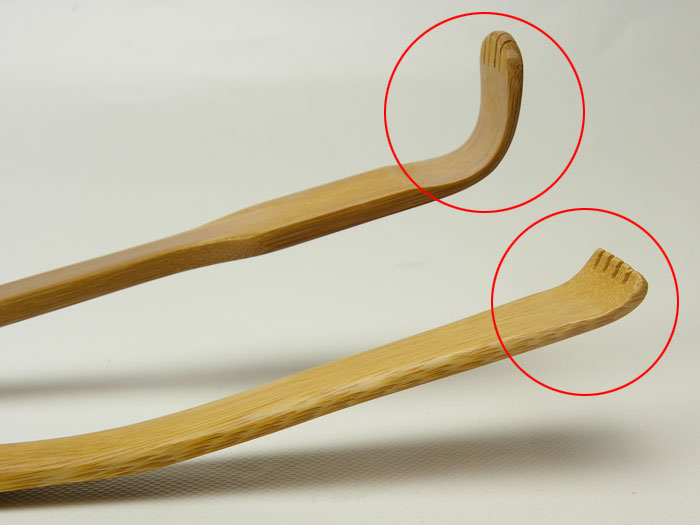
There's a slime called マゴノテ:
Literally, this means "back scratcher" in Japanese.
See the resemblance? The explanation for this slime's name could be as simple as that. However, my research uncovered a little bit of a story behind the Japanese word.
The kanji form of マゴノテ is 「孫の手」, which means "grandchild's hand."
If you go a little deeper - according to Wikipedia, the word was originally 「麻姑の手」(まこのて). "Mako" (麻姑) is the Japanese version of the Chinese deity Magu. Magu was a beautiful female immortal who had some association with the elixir of life, and was known for possessing long, claw-like fingernails.
There's apparently an expression - 「麻姑掻痒」(まこそうよう) - "Mako scratches the itch," which means something like "everything going according to one's desires."
Anyway, the word for "back scratcher" started off as a reference to the hands of Mako, which would be perfect for such a task. It seems "Mako" eventually morphed into "Mago" (grandchild), though, owing to the fact that the back scratcher's "hand" more closely resembles that of a child than a claw.
This brings us back to the eponymous slime. If I were officially translating the game, I'd be sure to clarify with the developer on this point. However, in my judgement he's referring to both the physical similarity between the slime and the shape of a back scratcher and the divine association of the goddess Mako. It seems that Mako had something to do with the elixir of life; meanwhile the slime's special ability is that when damaged it splits into two, restoring itself in a fashion.
Rather than translate its name as "Back Scratcher Slime" I thought it better sounding to stretch a little bit and kind of localize it as "Goddess' Hand." The meaning of the name may not really be clear to English speakers, but then there are tons of references to ancient religions and lore in all kinds of games (especially JRPGs) that casual gamers may not pick up.
Back Scratcher Image Source: Rakuten
Magu Image Source: Wikimedia
Thursday, July 3, 2014
The Economist on Machine Translation
There's a blog I follow called Hanzi Smatter, where readers send in pictures of tattoos in Japanese and Chinese, and the author explains their meanings. Spoiler: most of the time they are either gibberish or mean something other than what the inked subject originally thought they meant.
Anyway, the blog was mentioned last month in an Economist article about machine translation. Being that I do a bit of translation myself and am considering it as a possible career in the future, this is an area of great interest to me. Namely, with the rise of computer translation engines like Google Translate, will humans someday be crowded out of this job market by computers? The Economist promised a followup article on that topic,but I haven't found it if it's been published yet and here it is.
MT has come a long way, I'll grant. But Google Translate still churns out a lot of awkward and unnatural text, if it can even get to the base meaning of something. In translations where the source and target are similar, like English and Spanish or German, I imagine improvement may be quick and dramatic. I'm skeptical that leaps and bounds will be made for languages like Japanese, Thai, and Chinese or Korean paired with English. Here's a comment from the article that I think states well this belief (criticism of the publication itself aside):
Good to see MT discussed in the Economist.
Sad to see the same tropes get dragged out all over again. Bad sign translations? Really? Only seen that one in every single online article ever written on MT in the last decade.
One would hope the Economist (of all journals) would write something far more insightful than the 4,757th article full of gasping glee over "magic" technology or how much money Dell saved by using MT. (Ever wonder why Dell is the only TAUS company that keeps getting quoted over and over? Not that many "success stories," it turns out.)
OK, let's review a few dirty little secrets. They can be very revealing.
Dirty little secret #1. There is almost zero money in commercial-market MT. It's a barren desert of "consultants" and shockingly little cash flow. Every company that dips its toes into the water realizes that it cannot survive on hype and no cash. All the VC cash is pouring into platforms for human translation. There is a reason for this.
Dirty little secret #2. Human translation is a $34 billion global market with billion-dollar segments (law, finance, banking, marketing, media, government) where MT -- the perfect technology for fast, cheap and good enough -- will never work.
Dirty little secret #3. The engine driving MT is human translation. Google works by leveraging existing human translations in its databases and only when nothing is there does it lean on predictive algorithms. Hence, the massively uneven quality. If you subtracted all that human-translated content, Google would be a gibberish-producing laughingstock.
Oh, and Google itself does not use Google Translate for its own materials. Who would be silly enough to do that?
If this article were on Internet privacy, we would have just read the version the NSA wants us to read.
I would hope the Economist would get more serious as a journalistic enterprise in exploring the far more fascinating story (the real one) instead of the one just spoon-fed to it by organizations like TAUS, which have their own agenda.
My own brief followup anecdote:
At work, my colleagues and I find and clip articles from major US publications relating to developments in the telecom industry or telecom public policy. Each day we send the ones we choose to a translator, who sends them back in Japanese. Recently we were told by our Factiva (a publication aggregating service that we subscribe to) account representative that there is a tool within the interface that allows for some articles to be translated to Japanese. I expressed skepticism, but she told me she was confident that they would be of good quality and to check out the tool. I did so, and this is what I found -
Their fancy tool is actually just Google Translate. And thus I lost confidence that our account representative really knows what she is talking about.
Anyway, the blog was mentioned last month in an Economist article about machine translation. Being that I do a bit of translation myself and am considering it as a possible career in the future, this is an area of great interest to me. Namely, with the rise of computer translation engines like Google Translate, will humans someday be crowded out of this job market by computers? The Economist promised a followup article on that topic,
MT has come a long way, I'll grant. But Google Translate still churns out a lot of awkward and unnatural text, if it can even get to the base meaning of something. In translations where the source and target are similar, like English and Spanish or German, I imagine improvement may be quick and dramatic. I'm skeptical that leaps and bounds will be made for languages like Japanese, Thai, and Chinese or Korean paired with English. Here's a comment from the article that I think states well this belief (criticism of the publication itself aside):
Good to see MT discussed in the Economist.
Sad to see the same tropes get dragged out all over again. Bad sign translations? Really? Only seen that one in every single online article ever written on MT in the last decade.
One would hope the Economist (of all journals) would write something far more insightful than the 4,757th article full of gasping glee over "magic" technology or how much money Dell saved by using MT. (Ever wonder why Dell is the only TAUS company that keeps getting quoted over and over? Not that many "success stories," it turns out.)
OK, let's review a few dirty little secrets. They can be very revealing.
Dirty little secret #1. There is almost zero money in commercial-market MT. It's a barren desert of "consultants" and shockingly little cash flow. Every company that dips its toes into the water realizes that it cannot survive on hype and no cash. All the VC cash is pouring into platforms for human translation. There is a reason for this.
Dirty little secret #2. Human translation is a $34 billion global market with billion-dollar segments (law, finance, banking, marketing, media, government) where MT -- the perfect technology for fast, cheap and good enough -- will never work.
Dirty little secret #3. The engine driving MT is human translation. Google works by leveraging existing human translations in its databases and only when nothing is there does it lean on predictive algorithms. Hence, the massively uneven quality. If you subtracted all that human-translated content, Google would be a gibberish-producing laughingstock.
Oh, and Google itself does not use Google Translate for its own materials. Who would be silly enough to do that?
If this article were on Internet privacy, we would have just read the version the NSA wants us to read.
I would hope the Economist would get more serious as a journalistic enterprise in exploring the far more fascinating story (the real one) instead of the one just spoon-fed to it by organizations like TAUS, which have their own agenda.
My own brief followup anecdote:
At work, my colleagues and I find and clip articles from major US publications relating to developments in the telecom industry or telecom public policy. Each day we send the ones we choose to a translator, who sends them back in Japanese. Recently we were told by our Factiva (a publication aggregating service that we subscribe to) account representative that there is a tool within the interface that allows for some articles to be translated to Japanese. I expressed skepticism, but she told me she was confident that they would be of good quality and to check out the tool. I did so, and this is what I found -
![]() |
| Ta-daaa! |
Saturday, January 4, 2014
Akeome 2014
あけましておめでとうございます and 今年もよろしくお願いします!
I know it's been a while, and I feel like I need to get back to it. Thus, behold this blog's new visage! I picked out a new premade template and Microsoft Painted the banner graphic myself.
So what have I been up to? For starters, a friend of mine informed me that Japanese website Cookpad is currently hiring translators to move more user-submitted recipes to their English website. I, in my ignorance, didn't even know they had an English website. Well, long story short I applied and was hired. I sent over my paperwork last week, and so any day now I should have my translating powers enabled and will be Englifying J-recipes in my free time.
I took the JLPT N1 in the beginning of December. Like I did with the N2, I was scouting it out...and it was tough. Mission accomplished. I do think that with some discipline and routine I may be able to pass it this year. I guess we'll see.
I also reapplied to JET - this time for a CIR position. I think they'll give me a serious look - my experience is solid, and my Japanese is at a decent level. But I've heard that the competition in DC is tough, so fingers crossed. If I do get hired again, the plan right now is to go back, become hella good at Japanese (that's at least one step above JLPT N1), and then see where I'm at. With good enough language skills I may consider going into translation if the international relations and business fields don't seem right.
JETAADC has also taken a lot of my time. I've been helping out with this and that as the volunteer chair since last March. It took me a year and change after coming back home to get involved with the JET alumni community. If you find yourself in a similar boat, I encourage you to participate. It really is a great way to make connections and reminisce about Japan. Even if you're not a former JET, feel free to look for events in your area. Our JETAADC events, for example, are often open to friends and family of JET and are sometimes co-hosted by other Japan-related organizations that are open to everyone.
Oh, and I just started studying a little Korean. I don't intend to get serious with it until I'm more satisfied with my Japanese, but I'd like to at least get my foot in the door and learn some hangul and basic vocab. If anyone reading this has studied Korean, any tips or resource suggestions would be most welcome!
That's it for now. I'll be back soon with some more (Japanually) substantive posts.
I know it's been a while, and I feel like I need to get back to it. Thus, behold this blog's new visage! I picked out a new premade template and Microsoft Painted the banner graphic myself.
So what have I been up to? For starters, a friend of mine informed me that Japanese website Cookpad is currently hiring translators to move more user-submitted recipes to their English website. I, in my ignorance, didn't even know they had an English website. Well, long story short I applied and was hired. I sent over my paperwork last week, and so any day now I should have my translating powers enabled and will be Englifying J-recipes in my free time.
I took the JLPT N1 in the beginning of December. Like I did with the N2, I was scouting it out...and it was tough. Mission accomplished. I do think that with some discipline and routine I may be able to pass it this year. I guess we'll see.
I also reapplied to JET - this time for a CIR position. I think they'll give me a serious look - my experience is solid, and my Japanese is at a decent level. But I've heard that the competition in DC is tough, so fingers crossed. If I do get hired again, the plan right now is to go back, become hella good at Japanese (that's at least one step above JLPT N1), and then see where I'm at. With good enough language skills I may consider going into translation if the international relations and business fields don't seem right.
JETAADC has also taken a lot of my time. I've been helping out with this and that as the volunteer chair since last March. It took me a year and change after coming back home to get involved with the JET alumni community. If you find yourself in a similar boat, I encourage you to participate. It really is a great way to make connections and reminisce about Japan. Even if you're not a former JET, feel free to look for events in your area. Our JETAADC events, for example, are often open to friends and family of JET and are sometimes co-hosted by other Japan-related organizations that are open to everyone.
Oh, and I just started studying a little Korean. I don't intend to get serious with it until I'm more satisfied with my Japanese, but I'd like to at least get my foot in the door and learn some hangul and basic vocab. If anyone reading this has studied Korean, any tips or resource suggestions would be most welcome!
That's it for now. I'll be back soon with some more (Japanually) substantive posts.
Labels:
2014,
cir,
JET,
korean,
translation
Tuesday, September 10, 2013
My first freelance translating experience
Keep those connections alive - especially those JET alumn among you!
A couple months ago I exchanged a few messages on Facebook with a JET friend of mine who I keep in loose touch with. Our time in Hyogo overlapped for a couple of years and we hung out now and then with mutual friends. These days she's working as a professional Spanish to English translator in Ireland, and I was picking her brain a little about her experiences with and leading up to that, as I see J>E translation as a definite possibility on my horizon.
Fast forward to last week. She sent me a brief message that an old college friend of hers who's now working at a translation agency was looking for someone to translate a Japanese article to English and that she'd like to put us in touch. I agreed and thanked her, and was on my way to my first paid translation gig.
Ultimately over the course of about a week I wound up doing one translation and proofing another assigned to someone else. I don't know if the agency will contact me again to see if I'd like to do more work from them, but if so I'm going to decline for now.
I'm really grateful that I have that experience under my belt. Provided I can reach the right point and attract enough business, I could see myself being content or maybe even happy doing that kind of work. At this point, though, it's just not time effective, and I don't think my abilities are quite where they need to be. The translation was about 1800 words (roughly two pages of Japanese text) and it took me about 12 or so hours to translate and finetune it. And I had to ask some people for help with a few tricky sentences (didn't help that the article was written with some strange grammar, as a couple of my Japanese coworkers pointed out).
They sent me the final, proofed versions of the articles this morning. They made some minor changes to the article I did, mostly playing with wording, and they did take some of the editing suggestions I made for the other piece. I'm not sure how long it'll be before I'm able to consider doing translation as a career, but I'd say this particular job was a valuable experience and a success. And the extra money this month won't hurt, either.
Thursday, May 23, 2013
Japan Blog Matsuri: It's all about context
Holy shinola, it's been a while since I've posted. There's a backlog of things I've been meaning to share, but I fear that time has gotten away from me. I've gotten quite a bit busier and posting regularly seems to have fallen by the wayside. These things happen, but I do need to redouble my efforts. Anyhow, moving on - it's also been a while since the last Japan Blog Matsuri. I was contacted last month by Declan of KanaKanji, who's making a move to revive it, and asked if JADJ would submit something. Well, we always do our best here to oblige.
The theme of this month's Matsuri is "Japanese in Context." Specifically I think we're asked to talk about some Japanese that was really solidified for us in a particular context. I'm doing to stretch the theme a little bit, though (申し訳ない!) and talk a bit more broadly.
If you're reading this, chances are you either know first hand or have heard that Japan has a pretty high context culture. This is built into the language. The grammar, conversational style, and vocabulary lend themselves towards subtly and indirectness. This means that without a context, it is extremely difficult if not impossible to understand precisely what's going on in Japanese (written and spoken elements with their own respective challenges). Japanese nouns and verbs normally have no distinction between singular and plural forms. Last names are often used without any kind of gender-indicative title. Subjects and objects are often implied. Take a simple sentence like 「りんごを食べる」. This could presumably be translated into English as "He/she/you/I/it (will) eat(s) (an/the) apple(s)." There are probably dozens of possible meanings for this simple two-word sentence, depending on who the subject is, whether we're talking about now or in the future (or in general), how many apples we're talking about, and whether the apple(s) in question is specific or not.
I've been thinking about this kind of thing a lot lately as I contemplate the practicality of shifting my career goals towards pursuing professional translation.
A good example of the import of context (and this is uniform for any language) can be found in the case of homophones (同音異義語). Three or four weeks ago I started taking another weekly Japanese class, and we've been briefly studying a few of these every class. Just as a refresher, homophones are multiple words that share the same pronunciation but differ in meaning and sometimes spelling. Like "fair" and "fare."
Japanese has a fair share of these that usually have different kanji and sometimes slightly different intonation. Hashi - 橋 (bridge) and 箸 (chopsticks) springs to mind. When you add 熟語 (kanji compounds), there are quite a lot of these. I think this is one of the more difficult but also more interesting elements of learning Japanese - seeing all of the ways that kanji can be cobbled together to create new words. Well, it is for me, anyway.
Monday, January 28, 2013
Good heart-ism
So recently we got kind of screwed over by Dell in our office. I won't go into boring detail, but suffice it to say Amazon.com took care of us (as we ordered through them) after Dell gave us the runaround on faulty equipment.
Today my boss declared that Amazon was 良心的 (りょうしんてき), and asked me what that is in English. I told him I wasn't sure, and he said "maybe something like 'kind?'" When he suggested that word choice, I was able to surmise what kanji the word uses, and I guess I've heard it before. I'm not exactly sure that 「良心的」has a direct, clean English translation (maybe "fair," "honest," or "conscientious"), but the word itself is a good example of how straightforward some terms can be in Japanese. The kanji are "good" (良), "heart" (心), and 「的」, which is kind of like "~ism" or "~like."
Labels:
japanese,
translation,
日本語,
良心的
Subscribe to:
Posts (Atom)